Runners List


The Runners List is one of the windows in a Race View document. The Runners List shows the list of Runners for a Race.
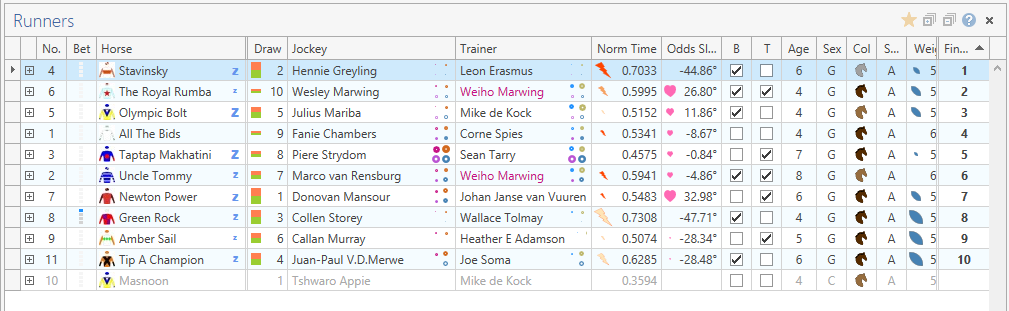
Scratched Horses are shown in light grey text. Depending on the sort order of the columns, these may be placed at the bottom of the list.
Columns may rearranged by dragging, sorted by clicking on the header or fixed by selecting the appropriate action from the menu when right-clicking on the column header.
Some column cells have symbols to visually represent the value, scaled according to the position of the value compared to the value of other Runners. Below is a list of the columns available and the meaning of the symbols.
Column |
Description |
||||||||||||
No. |
Runner Saddle Number |
||||||||||||
Bet |
Bet Indicator. Only visible if bets have been placed on this race. These symbols indicate that a bet has been placed on the runner and the type of bet. There may be more than one bet on a runner and if the bet spans multiple runners the other runners affected will have a symbol in the same column.
If a runner with a bet on is selected, the runner will be highlighted in the Race Bets window. If a bet is selected in the Race Bets window, the bet indicator and runner will be highlighted in the Runners List. |
||||||||||||
Horse |
Owner silk image, horse name and recent runs indicator. The e.g. In any particular race, if the most runs a horse has had in the last three months is four and the minimum runs is zero, a horse with zero runs will have a full-sized symbol, a horse with two runs will have a medium-sized symbol and a horse with four runs will have no symbol. In another race, a horse with four runs may have a full-sized symbol if that is least runs any of the runners have had. |
||||||||||||
Draw |
Starting gate draw and draw statistics indicator. The symbol shows the draw win bias in orange and the draw place bias in green. The scale of each part is calculated from the linear regression slope of the draw statistics for the race course and distance and the draw position. If there is a strong bias towards one side of the track (i.e. the slope of the regression line is steep), the symbol will be taller for the first draw on that side of the track and decrease as the draw gets further away. If there is not much bias (the slope is shallow) the symbols will start smaller and decrease further. For more information on how the draw statistics are calculated, see the Draw Stats help topic. |
||||||||||||
Jockey |
Jockey name and statistics indicators. The circle symbols are a representation of the statistics for the jockey and the jockey+trainer. The top left circle represents the win percentage of the jockey for the last six months. A win percentage of 25% will be shown as a full-sized circle with it getting progressively smaller as the win percentage decreases. The top right circle shows the jockey place percentage for the last six months. A place percentage of 50% will be shown as a full-sized circle.The bottom left circle represents the jockey+trainer win percentage and the bottom right circle the jockey+trainer place percentage. The thickness of the circle lines is also relevant. The line will be thinest if the statistic was derived from less than five runs and progressing to maximum thickness if there have been more than 50 runs. e.g. if a jockey has only had one run and won on that ride, the win percentage circle will be large but the line will be thin. For more information on the jockey statistics, see the Jockey and Trainer Stats help topic. |
||||||||||||
Trainer |
Trainer name and statistics indicators. The circle symbols, like the jockey circle symbols, represent the statistics for the trainer and jockey+trainer. The top left circle represents the trainer's win percentage for the last six months and the top right circle the trainer's place percentage. The bottom left and right circles are the jockey+trainer win and place percentages and will be the same as shown at the bottom of the jockey cell. When a trainer has more than one runner in a race, that trainer's name will be assigned a colour and the trainer name will highlighted in the same colour for all of the trainer's other runners. For more information on the trainer statistics, see the Jockey and Trainer Stats help topic. |
||||||||||||
B |
Blinkers. Checked if the horse will be wearing blinkers. |
||||||||||||
T |
Tongue tied. Checked if the horse will be wearing a pacifier. |
||||||||||||
Age |
Age of the horse rounded to the nearest year. |
||||||||||||
Sex |
Gender of the horse. C = Colt (male <= 5 years) G = Gelding (castrated male) H = Horse (uncastrated male > 5 years) F = Filly (female <= 5 years) M = Mare (female > 5 years) |
||||||||||||
Col |
Colour of the horse
|
||||||||||||
Shoes |
The type of horse-shoes the horse will be wearing. A = Alumites a = Alumites (front only) S = Steel s = Steel (front only) L = Surgical Y = Plastic Z = Alumite bar blank = unshod |
||||||||||||
Weight |
The weight the horse will be carrying in kilograms.The symbol (reminiscent of a feather) is inversely scaled using unitary normalisation. This means that the runner carrying the lowest weight will have the largest symbol and the runner with the most weight will have no symbol with all other weights scaled appropriately. This scaling takes into account any apprentice allowance. |
||||||||||||
Allow |
The weight in kilograms the apprentice riding is allowed to deduct from the Weight. This is factored into the Weight symbol. |
||||||||||||
MR |
Merit Rating and symbol. This column shows the Merit Rating value of the runner on the day as determined by the handicapper. The symbols are scaled according to unitary normalisation of the values, with the highest having a full-sized symbol and the lowest no symbol and all other values scaled accordingly. |
||||||||||||
Star |
This is a rating given to the horse and is meant to be a finished article on the chances of each runner in the race. |
||||||||||||
Norm Time |
Average Normalised Time and symbol. This value gives an idea of the speed of the horse and allows a comparison to the speed of other runners. It is calculated by taking the last 20 runs of the horse, then for each run calculating a unitary normalised value for the run time using the slowest and fastest times recorded for that track, distance and going. These normalised time values are then averaged to provide this value. The symbol is then scaled according to the unitary normalised value for each runner. i.e. The runner with the fastest average time will have a full-sized symbol and the slowest will have no symbol with the others scaled according to how close they are to the maximum and minimum values. The colour of the symbol indicates how many runs the average normalised time was generated from as the runner may not have had 20 runs.
|
||||||||||||
Grade Ave |
Previous runs grade average. This values is intended to show whether the horse is moving up or down in grade. It is calculated by taking the Race Grade (A..G) and the last ten runs for the horse, then for each grade away from the current grade a value is added or subtracted. e.g. If the current Race is Grade B and the horse has had three runs which were Grade C, Grade D and Grade A, the value will be (-1) + (-2) + (1). So a negative value will mean that the horse is, on average, moving up in grade and a positive value means it is moving down in grade. |
||||||||||||
Earnings |
The lifetime earnings of the horse. The $ symbol is scaled according to the unitary normalised earnings of the other runners. |
||||||||||||
Open Bet |
This is the price that a fixed odds bet operator initially priced the runner at. The display format respects the Odds Display System Setting. |
||||||||||||
Close Bet |
This is the fixed price that was available on the runner when the betting for the race closed. The display format respects the Odds Display System Setting. |
||||||||||||
Latest Win and Place Odds Columns |
There a multiple win and place odds columns showing the latest odds from selected bet operators and more may be added in the future. The odds are fetched from the bet operators at fixed intervals which become more frequent closer to the race and the application also refreshes its view automatically on a fixed interval. Please be aware that there may be up to a minute's delay in showing the latest odds 15 minutes or less before the race with that delay getting larger the further ahead in time the race is. For more information please see the help topic Odds List. The source of the odds is indicated by an image in the column header representing the bet operator. The Tote odds are available from two sources but only one will be displayed in the grid. They should be the same, but you can select which one you prefer on the main toolbar by choosing "Tote Source". Whether the odds are for a win or a place is also indicated in the column header by the text "Win" or "P (n)" where n is the number of places that the particular bet operator will pay. The column backgrounds for win odds are shaded blue-green and the place odds backgrounds are shaded red. The display format respects the Odds Display System Setting.
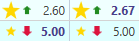
In addition to the latest odds value there are possibly two symbols that may appear next to the value. The first five runners with the lowest odds (favourites) will have a gold star next to their odds. This is per column so the runner may not have a star (or a different size star) in another column showing that they may not be as favoured at another operator or a different bet type (win or place). The star is scaled according to the lowest odds by the formula (odds / favourite odds) so the favourite will always have a full-sized star and, if the price is double for the second favourite, it will have a half-sized star. The red or green arrows indicate the trend (rather than last movement) of the market for that runner, bet type and operator. The scale and colour are determined by the linear regression line slope of the last ten points of the odds plotted on a chart of time vs. value. e.g. If the price is dramatically shortening, the slope will be positive and steep, so the arrow will be large and green. If the odds have slowly been getting longer, the slope will be negative and shallow, so the arrow will be small and red. The best odds from any operator for a particular bet type are shaded dark-blue and bold. Note that for place odds different operators may pay a different number of places so the highest number may not be the best value. Columns may be pinned to the right side of the grid by right-clicking on the column header and selecting fixed:right. As a shortcut, odds columns may be quickly pinned or hidden by clicking on the button "Toggle Fixed Odds Columns".
|
||||||||||||
Odds Slope |
The Love column. This is an average of all the trend slopes from all operators and all bet types for the runner. The symbol is then scaled according to the unitary normalised average trend slope values of the other runners, so the runner that has seen the most positive market movement will have the largest symbol and the the runner with the least will have no symbol. |
||||||||||||
Bayes (Win) J48 (Place) Ridor (Place) |
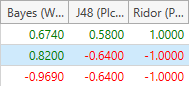
These are the predictions from various machine-learning algorithms trained using supervised learning on past results. The inputs to these algorithms have been experimentally determined to give the best chance of being correct given the available data and the predictions are updated constantly if any inputs change. Bayes (Naive Bayes) (Win): This is the chance that the Runner will win. Green indicates that it will and red that it won't. The number value is the confidence that the prediction will be correct with values between zero and one (more confident the closer to 1). If the value is negative (red), ignore the sign and the value is the confidence that the Runner will NOT win (so -0.7800 has more chance of winning than -0.9690). This value will likely only change if there is a scratching or a jockey change. Observation over two years shows this prediction to have 40% chance of being correct. J48 (Place): This is the chance that the Runner will place. Green indicates that it will and red that it won't. The value indicates the confidence of the prediction. This value may change frequently until the race starts as one of the inputs used to make the prediction is the market trend. Observation over two years shows this prediction to have 69% chance of being correct. Ridor (Place): This is the chance that the Runner will place. Green indicates that it will and red that it won't. The value will only be positive or negative 1.000. This value may change frequently until the race starts as one of the inputs used to make the prediction is the market trend. Observation over two years shows this prediction to have 72% chance of being correct. If all 3 are green, the Runner has a 75% chance of achieving a place. Unfortunately the average odds for this bet are 26/100 which is below the 33/100 required to break even, so don't just bet on this scenario every time it occurs. If you decide to only bet when the odds are > 33/100, the winning percentage also decreases. |
||||||||||||
Lengths |
Lengths behind the winner. This column will become visible after the race has closed and will be populated as soon as the data is available. |
||||||||||||
Finish |
Finish position. This column will become visible after the race has closed and will be populated as soon as the data is available (the first four finish positions will be populated as soon as the provisional results are available). |
||||||||||||
Form
Clicking the [+] symbol, double-clicking or pressing Enter on a runner will expand the form view. This will open a tabbed control with three tabs.
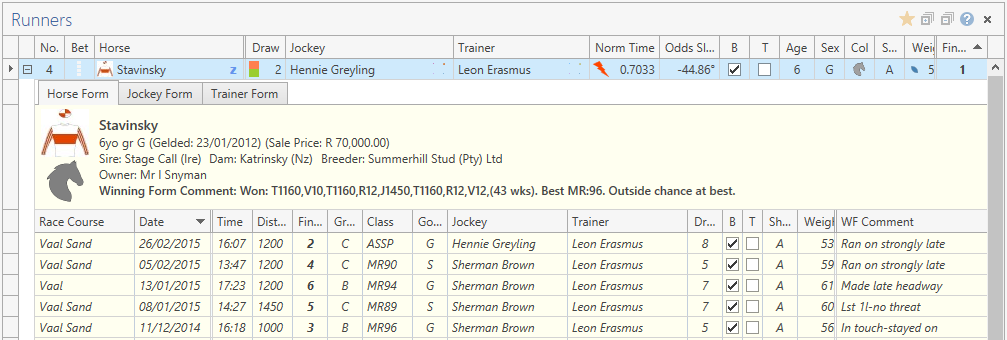
Horse Form Tab
An information panel shows an image of the owner's silks, horse colour and other information about the horse. Below is a grid showing information about the last 20 runs for that horse.
Jockey Form Tab
A grid shows information about the last 20 runs for the runner's jockey.
Trainer Form Tab
A grid shows information about the last 20 runs for the runner's trainer.
Double clicking or pressing Enter on any row will drill-down to that runner by opening a race view document and highlighting that runner.
Created with the Personal Edition of HelpNDoc: Write EPub books for the iPad